

Male Breast Reduction in Denver
Expert male chest contouring with Dr. Aline Rau
What is male breast reduction?
Male breast reduction, or gynecomastia surgery, removes the excess glandular tissue and fat that make a man's chest look full or rounded, so it sits flat and firm the way it should. Depending on what's causing the fullness, Dr. Aline Rau uses liposuction, direct removal of the gland through a small incision at the edge of the areola, or both.
At Amavi Aesthetic Surgery in Denver, Colorado, we help men address gynecomastia, a condition characterized by excess glandular tissue or fatty deposits in the chest. This can create a more feminine appearance and affect confidence and self-esteem.
Our lead plastic surgeon, Dr. Aline Rau, focuses on precision and personalized care to sculpt a masculine chest contour. If you've been keeping your shirt on at the pool, choosing dark or loose tops, or avoiding the gym because of your chest, this procedure is designed to fix exactly that.
Male breast reduction is one of the breast procedures Dr. Aline Rau performs at Amavi.
What happens during gynecomastia surgery?
Gynecomastia surgery is an outpatient procedure performed under general anesthesia, so you go home the same day. Dr. Aline Rau tailors the technique to your chest: how much of the fullness is fat, how much is firm glandular tissue, and whether the skin will settle on its own.
Dr. Aline Rau discreetly places incisions around the areola or natural chest creases, ensuring minimal visibility while precisely removing excess glandular tissue and fat.
Using advanced techniques and an artistic approach, she sculpts a masculine, natural-looking chest contour that enhances your unique anatomy.
Most men are in and out the same day. You'll go home in a compression vest, and we'll see you within a week at your first post-op appointment.
Liposuction, gland removal, or both: which will I need?
It depends on what's under the skin. Fat responds to liposuction. Firm glandular tissue doesn't, and has to be removed directly. Most men have a mix of the two, so most male breast reductions combine both.
Dr. Aline Rau will tell you which option works best for you during your exam at your consultation. Here's how the three approaches compare:
Liposuction only
For chest fullness that's soft and pinchable, with no firm tissue under the nipple. Fat is removed through one or two tiny incisions in the chest crease or near the armpit.
- Smallest incisions, fastest recovery
- Best when the skin is tight and will shrink back
- Often the right fit after weight loss when only fat remains
Gland removal (excision)
For the firm, rubbery disc of breast tissue that sits behind the nipple and doesn't respond to diet, exercise, or liposuction. It's removed directly through a short incision along the lower edge of the areola.
- Flattens the puffy-nipple look
- Scar hides in the color change at the areola edge
- Tissue that's removed does not grow back
Combined liposuction and gland removal
Most men have both fat and glandular tissue, so most male breast reductions at Amavi combine the two in one procedure. Liposuction blends the edges so the chest looks naturally flat rather than scooped, and gland removal addresses the area liposuction can't reach.
If your skin has been stretched for years or you've lost a lot of weight, including on GLP-1s like Ozempic, Dr. Aline Rau may also remove a small amount of skin so the chest lies flat. That's a conversation about the trade-off between a flatter result and a slightly longer scar.
What causes gynecomastia?
Gynecomastia is an imbalance between estrogen and testosterone that tells breast tissue to grow. Sometimes there's a clear trigger, and often there isn't. Knowing which type you have matters, because fat and glandular tissue are treated differently.
True gynecomastia
Real breast gland tissue has grown behind the nipple. It feels like a firm, rubbery disc, and the nipple often looks puffy or pointed. Diet and exercise won't shrink it. Treated with direct gland removal, usually combined with liposuction.
Pseudogynecomastia
The fullness is fat, not gland. It feels soft all the way through and tends to go with overall weight. Weight loss helps, but the chest is often the last place fat leaves. Treated with liposuction, sometimes with skin tightening.
- Puberty hormone shifts that never fully reversed
- Anabolic steroids and some supplements
- Certain medications (Dr. Aline Rau will review your list)
- Weight gain, or weight loss that left loose skin
- Natural testosterone decline with age
- Underlying medical conditions, less commonly
How long does male breast reduction recovery take?
Most men return to desk work within a week, drive once they're off prescription pain medication, and, once Dr. Aline Rau clears them, can do chest and upper-body workouts around six weeks. You'll wear a compression vest for the first several weeks, and the final shape settles over three to six months.
Here's what to plan for at each stage:
-
🛌
Days 1 to 3: Rest, vest on
Home the same day in a compression vest. Tightness and soreness more than sharp pain, like the day after a hard chest workout. Sleep on your back with your head propped up, and take short walks around the house.
-
🩹
Days 4 to 7: Back on your feet
Most men are off prescription pain medication within a few days and driving once they are. Light daily activity is fine. No lifting, pushing, pulling, or reaching overhead yet.
-
💼
Week 1 to 2: Desk work
Back at a desk job within about a week; physical jobs take longer. Walking for exercise is fine. The vest stays on under your clothes.
-
🚶
Weeks 2 to 4: Lower body comes back
Legs, light cardio, and walking workouts return. Still no chest, shoulder, or heavy upper-body work. Bruising is mostly gone by now.
-
🏃
Weeks 4 to 6: Vest comes off, cleared for the gym
Dr. Aline Rau clears most men for full workouts, including chest and upper body, around six weeks. The compression vest comes off around the same time.
-
✨
Months 3 to 6: Final shape
Swelling keeps settling and the skin tightens to the new contour. This is when the chest looks the way you pictured it with your shirt off.
-
🤝
Ongoing: Continued support
First post-op visit within a week, then follow-ups at 1, 3, 6 months, and 1 year, with 24/7 aftercare access in between.
At Amavi Aesthetic Surgery in Denver, we prioritize your healing journey as much as the procedure. After your male breast reduction surgery, you can expect some temporary swelling, bruising, and soreness, all of which are manageable with prescribed medications and compression garments.
Most patients resume light activities within one to two weeks, while full recovery typically occurs over several months.
To ensure the best possible outcomes, we provide tailored aftercare guidance, including follow-up appointments and lifestyle recommendations. Remember, your body and its path to healing and recovery are uniquely yours.
At Amavi, we support your recovery with nutritional supplementation to support healing, customized postoperative supplies, and unlimited visits while you heal. We also support you through any unforeseen complications, so you can feel at peace.
What will my gynecomastia surgery scars look like?
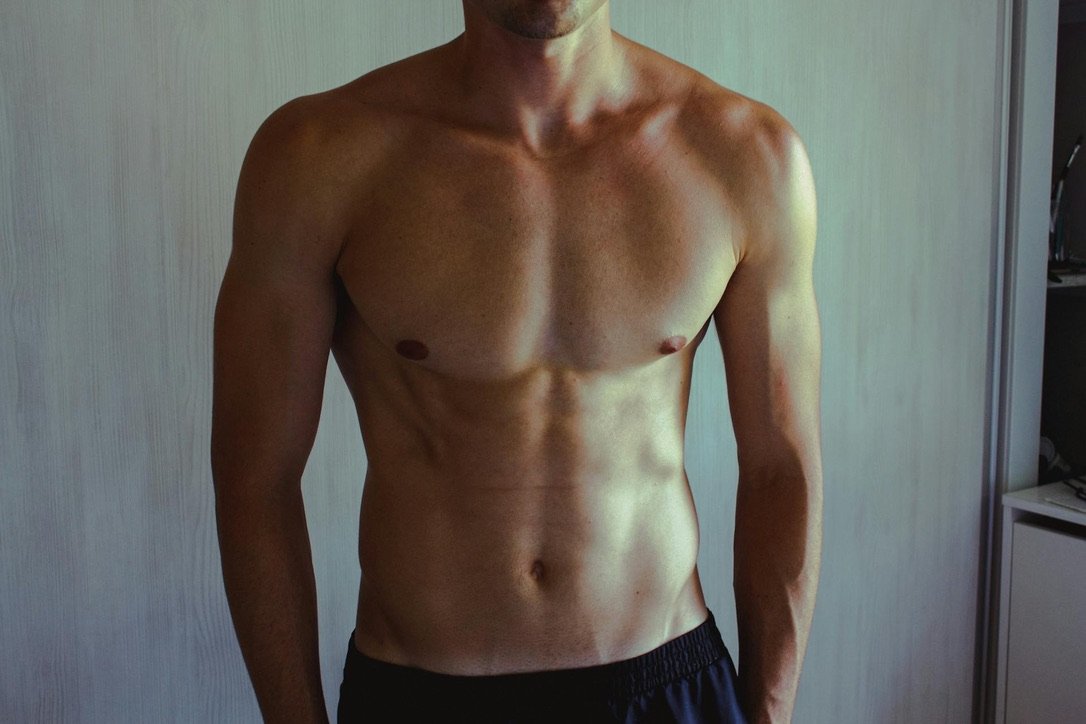
For most men, the scar is a short curved line along the lower edge of the areola, where the change in skin color hides it. If liposuction is part of your surgery, there are one or two additional incisions a few millimeters long, tucked into the chest crease or near the armpit.
Scars change a great deal in the first year. Expect the lines to look pink and slightly raised for the first few months, then flatten and fade over six to twelve months. If skin removal is part of your plan, the scar will be longer, and Dr. Aline Rau will show you exactly where it will be before you decide.
Our team will guide you on scar care at your follow-up visits so each line heals as thin and light as possible.

Am I a good candidate for male breast reduction?
Most healthy men whose chest fullness hasn't responded to diet and exercise are candidates for male breast reduction. A quick at-home check: if you can feel a firm, rubbery disc under the nipple, or your chest stays full even when the rest of you is lean, surgery is usually the answer. Dr. Aline Rau will give you an honest answer at your consultation.
Gynecomastia typically manifests as excess breast tissue or fatty deposits in men, often resulting in a more feminine-looking chest. Hormonal imbalances, specific medications, obesity, or genetics can drive this condition.
Regardless of the cause, it often leads to significant self-consciousness and diminished self-esteem. If this sounds familiar, you're not alone, and there's a way forward.
Surgery may be right for you if
- Your chest stays full or puffy at the nipple even when the rest of you is lean
- You can feel a firm, rubbery disc under the nipple
- Diet and exercise have changed everything except your chest
- Your weight has been stable for about six months
- You're a non-smoker in good health with realistic expectations about scars
Wait on surgery if
- You're still in your teens and the chest has changed in the last year
- You're actively losing weight, including while a GLP-1 dose is being adjusted
- You're still using anabolic steroids or a medication that may be causing it
- A hormone or medical cause hasn't been looked at yet
Is a women-owned practice the right place for gynecomastia surgery?
Plenty of men in Denver choose Dr. Aline Rau for exactly the reasons they'd hesitate. As a board-certified plastic surgeon with aesthetic fellowship training, she spends most of her operating time on breast and chest contouring, which is the skill set gynecomastia surgery calls for. Our boutique practice is private and small by design: you're not sharing a waiting room with a crowd, and the same team sees you from your first visit through your last follow-up.
You don't need to know the medical terms. Tell Dr. Aline Rau what bothers you and what you'd like to be able to do again, and she'll translate that into a plan.
Are male breast reduction results permanent?
Yes. Glandular tissue that's removed doesn't grow back, and fat cells removed with liposuction are gone for good. As long as your weight stays stable and the original cause (a medication, steroid use, a hormone issue) isn't still active, the flat chest you see at six months is the chest you keep.
Significant weight gain can add fat back to the area, just as it would anywhere else. Keeping a steady weight and staying active protects the result.
Your Questions About Male Breast Reduction, Answered
-
Gynecomastia surgery is an outpatient procedure. Most men are back at a desk job within a week, driving once they're off prescription pain medication, and cleared for full workouts, including chest exercises, around six weeks.
You wear a compression vest for the first several weeks. Swelling improves over 6 to 12 weeks, and the final contour settles within 3 to 6 months.
-
Most men describe the first few days as tight and sore rather than sharply painful, more like a hard chest workout than an injury. Prescription pain medication is usually needed for only a few days, and the compression vest helps more than people expect.
By the end of the first week, most patients are back to their routine.
-
Every surgery leaves a scar, but this one is placed where it hides: a short curved line along the lower edge of the areola, plus one or two tiny liposuction incisions in the chest crease or near the armpit.
Scars look pink for the first few months and fade over six to twelve months. If skin removal is needed, the scar will be longer, and Dr. Aline Rau will show you where it will be before you decide.
-
Removed glandular tissue doesn't grow back, and fat cells removed with liposuction are gone permanently. Results last as long as your weight stays stable and the original cause isn't still active.
Anabolic steroids, certain medications, and significant weight gain are the main things that can bring fullness back, which is why Dr. Aline Rau asks about them at your consultation.
-
Only if the fullness is fat. Firm glandular tissue doesn't respond to liposuction, diet, or exercise, and has to be removed directly through a small incision at the areola. Most men have a mix of both, so most procedures combine liposuction with gland removal. Dr. Aline Rau can tell which you have with a hands-on exam.
Learn more about liposuction in Denver.
-
Gynecomastia is common during puberty and often resolves on its own within a couple of years, so Dr. Aline Rau generally recommends waiting until growth is complete and the chest has been stable for at least a year. Adults of any age can be candidates as long as they're healthy and their weight is steady.
-
The cost depends on the technique you need: liposuction only, gland removal, or both, and whether any skin is removed. We don't accept insurance for gynecomastia surgery.
Dr. Aline Rau reviews all of this at your consultation, and you leave with a personalized quote for your exact plan. Financing options are available; see our financing page for details.
What Our Patients Say
Book your consultation
Ready to stop thinking about your chest?
Book a consultation with Dr. Aline Rau, a board-certified plastic surgeon in Denver, and explore your options for a personalized male breast reduction. Not sure what to expect at a first visit? Read our guide to the plastic surgery consultation.
Call us at (303) 381-0919 or complete the form below.